

Last updated: October 3, 2026
What is a Loyalty Program in Retail?
A loyalty program is an effective tool in retail to build an ongoing relationship between a customer and a brand, outlet, or business. Such programs perform several functions by providing well-deserved rewards and bonuses for frequent purchases or for fulfilling certain conditions. A well-run program can:
- Stimulate repeat purchases
- Increase the attractiveness of the brand
- Strengthen the emotional connection with the customer
- Improve overall loyalty
- Increase company profits
This system can include accumulative points, discounts, coupons, cards, gift certificates, exclusive offers, or individualized recommendations that encourage customers to make new purchases and remain loyal to a brand.
Types of Retail Loyalty Programs
Retail loyalty programs come in several distinct forms, and most retailers combine more than one.
- Cashback. Customers are refunded a portion of what they spend, as bonuses or real money, that can be used in the future.
- Loyalty card. A personalized card that accumulates points or discounts based on purchase volume. Points can be exchanged for goods, discounts, or other benefits.
- Discount card. Guarantees a fixed or progressive discount for regular customers.
- Bonus system. Customers accumulate points for each purchase, redeemable for discounts or gifts.
- Multilevel programs. Tiers such as "silver," "gold," and "platinum" that offer different amounts of privileges depending on customer activity.
- Gamification. The program turns into a game where customers earn "rewards" for specific actions.
- Value-based programs. For example, planting a tree for every purchase, which helps form an emotional connection to the brand.
- Referral programs. Incentivize current customers to share information about the company with friends, coworkers, and family, rewarding recommendations and encouraging organic growth of the customer base.
- Rewards clubs. Customers pay a fee to join and then receive exclusive discounts or benefits.
Each option can be implemented effectively on its own, or combined, which helps when assessing the impact of these mechanisms on revenue and customer retention.
Advantages and Disadvantages of a Loyalty Program
Main advantages:
- Attracting a new target audience. Having a loyalty system is a good reason for a customer to choose your store over competitors. Stores often use sign-up bonuses to encourage first orders.
- Collecting customer data. The company receives primary data about its customers without additional research costs. Program participants fill in basic data on registration, and their purchase history then forms a detailed customer profile, revealing purchase frequency, volume, common product combinations, and favorites.
- Reduced customer churn. A member receiving regular benefits becomes less sensitive to small price fluctuations from competitors, since the value of the program (discounts, bonuses, personalized service) can outweigh a small price difference. Some retailers add gamification to deepen engagement: reaching a level, earning badges, unlocking discount tiers.
- Personalized offers. Using purchase history data, retailers can send customers personalized offers for products or categories they're interested in, for example a discount on a favorite coffee or on items related to a recent purchase.
Main disadvantages:
- Difficulty differentiating from competitors. Many companies offer similar point-accumulation or discount mechanisms. It becomes hard to build a program that genuinely stands out, and customers may enroll in several similar programs without feeling attached to any one of them, using each only for the immediate benefit rather than building a relationship with a specific brand.
- Implementation and support costs. Initial costs can include software development or integration with existing systems, a mobile app, staff training, and marketing materials. Ongoing costs include IT infrastructure maintenance, reward payouts, retention campaigns, and program administration staff.
- An increase in "discount hunters." Attractive rewards can draw in customers whose main motivation is the immediate benefit. These customers aren't necessarily loyal to the brand and can switch easily to a competitor offering a better promotion.
How to Analyze a Loyalty Program
Measuring whether a loyalty program is actually working requires tracking more than enrollment numbers. The main criteria to watch:
- LTV (Customer Lifetime Value). How profitable a customer is over the full course of their relationship with the brand.
- NPS (Net Promoter Score). A reputation indicator that assesses customer approval of a company, product, or service.
- Engagement Rate. How many customers are actively using the program, and how often.
- Average receipt of program participants. Whether loyal customers spend more compared to regular customers.
- Impact on revenue. Comparing program costs against the additional revenue it generates.
- Customer buying behavior analysis. Tracking changes in behavior that result from program participation.
- Control groups. Comparing customers who use the program against those who don't, to isolate the program's real effect.
A Closer Look at NPS
Net Promoter Score is one of the most common ways to gauge loyalty, and it's worth understanding in detail. NPS is measured through a simple survey question: "On a scale of 0 to 10, how likely are you to recommend our company/product/service to your friends or colleagues?" Responses fall into three groups:
- Promoters: score 9–10. Loyal customers who are highly likely to recommend the brand.
- Neutrals: score 7–8. Satisfied, but more easily swayed by competitors, and unlikely to actively recommend.
- Critics: score 0–6. Dissatisfied, and may actively recommend against the brand.
The score is calculated by subtracting the percentage of critics from the percentage of promoters:
NPS = (number of promoters − number of critics) / number of respondents × 100%
NPS ranges from -100 to +100. A worked example: with 1,500 respondents, 42% scoring 7–9 and 58% scoring 0–6, that's 630 promoters and 870 critics. NPS = (630 − 870) / 1500 × 100% = -16%.
Rough interpretation bands:
| NPS range | What it signals |
|---|---|
| -100% to 0% | Critics dominate; little attachment to the business |
| 1% to 30% | Generally favorable, but critics remain a significant share |
| 31% to 50% | Brand loyalty and criticism are roughly balanced |
| 51% to 70% | The loyalty program is working well |
| 71% to 100% | An ideal level of customer loyalty |
NPS alone isn't the full picture. It's worth tracking the number of loyal customers over time, alongside revenue and transaction volume, to avoid a situation where loyalty scores climb while customers remain inactive and don't actually buy.
Loyalty Programs as a Marketing Tool
A loyalty program is a core tool for marketing teams because it enables interaction with customers at every level. A well-implemented program creates a deeper connection with the customer: offering bonuses, discounts, or other benefits encourages repeated, higher spending, which lifts both sales and satisfaction.
It also functions as a data-collection tool. By analyzing sales, promotions, and discount usage within the program, retailers understand customer preferences and behavior more precisely, which makes offers and service more personalized, and marketing more targeted overall.
Loyalty Programs in Retail: Practical Applications
In retail specifically, loyalty programs accomplish several concrete goals:
- Attracting new customers. Sign-up discounts or starter bonuses motivate people to join.
- Data collection and analysis. Retailers gain visibility into purchase frequency, product popularity, and average receipt.
- Increased competitiveness. A loyalty program can be the deciding factor in which store a customer chooses.
- Building trust. Personalized offers create a sense of individual recognition among customers.
- Sales incentives. Promotions available only to members encourage purchases that wouldn't otherwise happen.
A successful program means customers are more likely to return to your store or choose your product or service over a competitor's. To confirm that, a retailer needs to track effectiveness consistently, to ensure the program is converting into real loyal customers and real revenue, not just enrollment numbers.
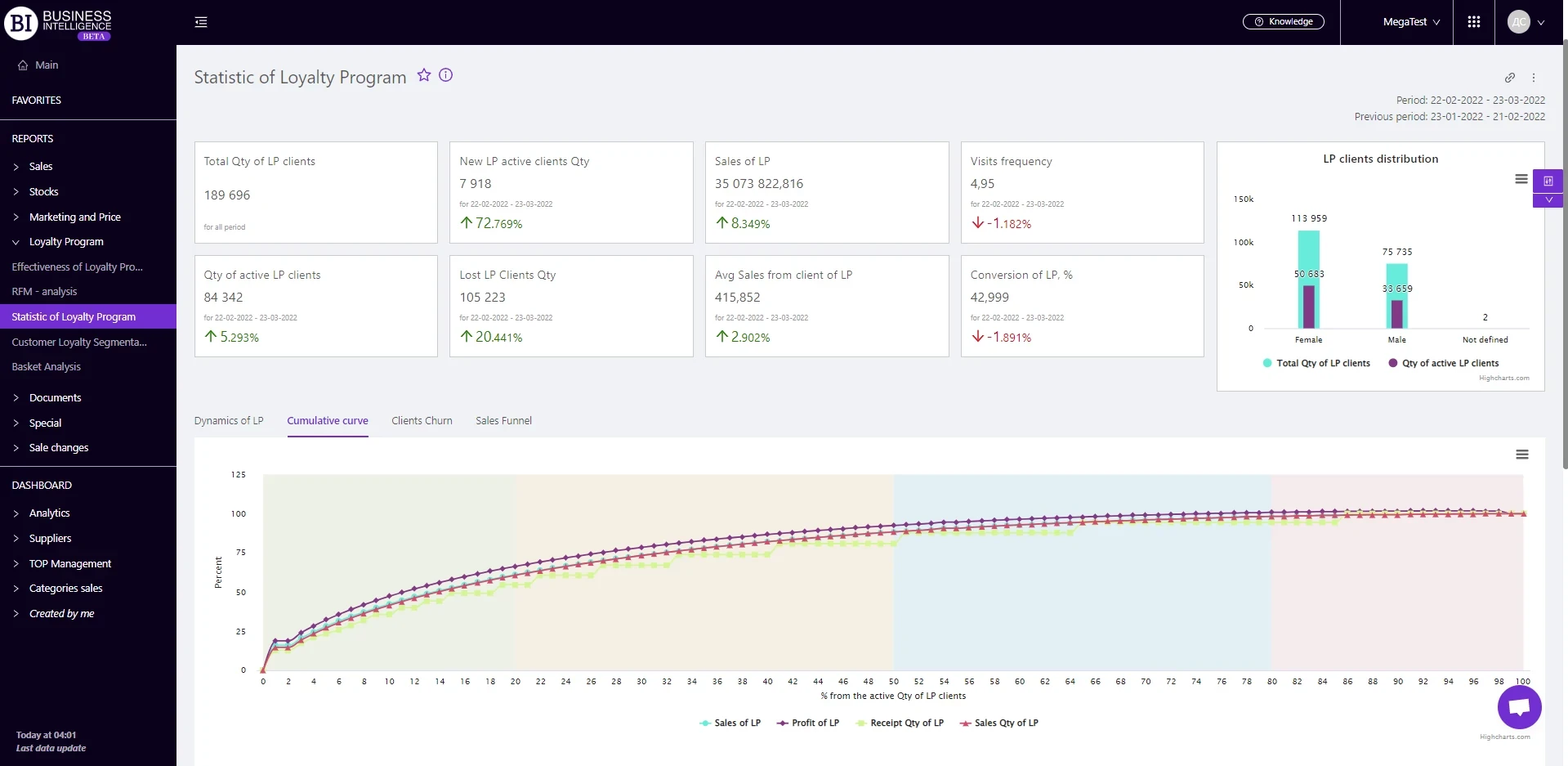
With BI data collection and retail analytics, retailers can measure customer loyalty directly rather than estimating it. Tracking customer, product, and revenue data together supports better strategic planning for loyalty initiatives. Two report types are particularly useful for this:
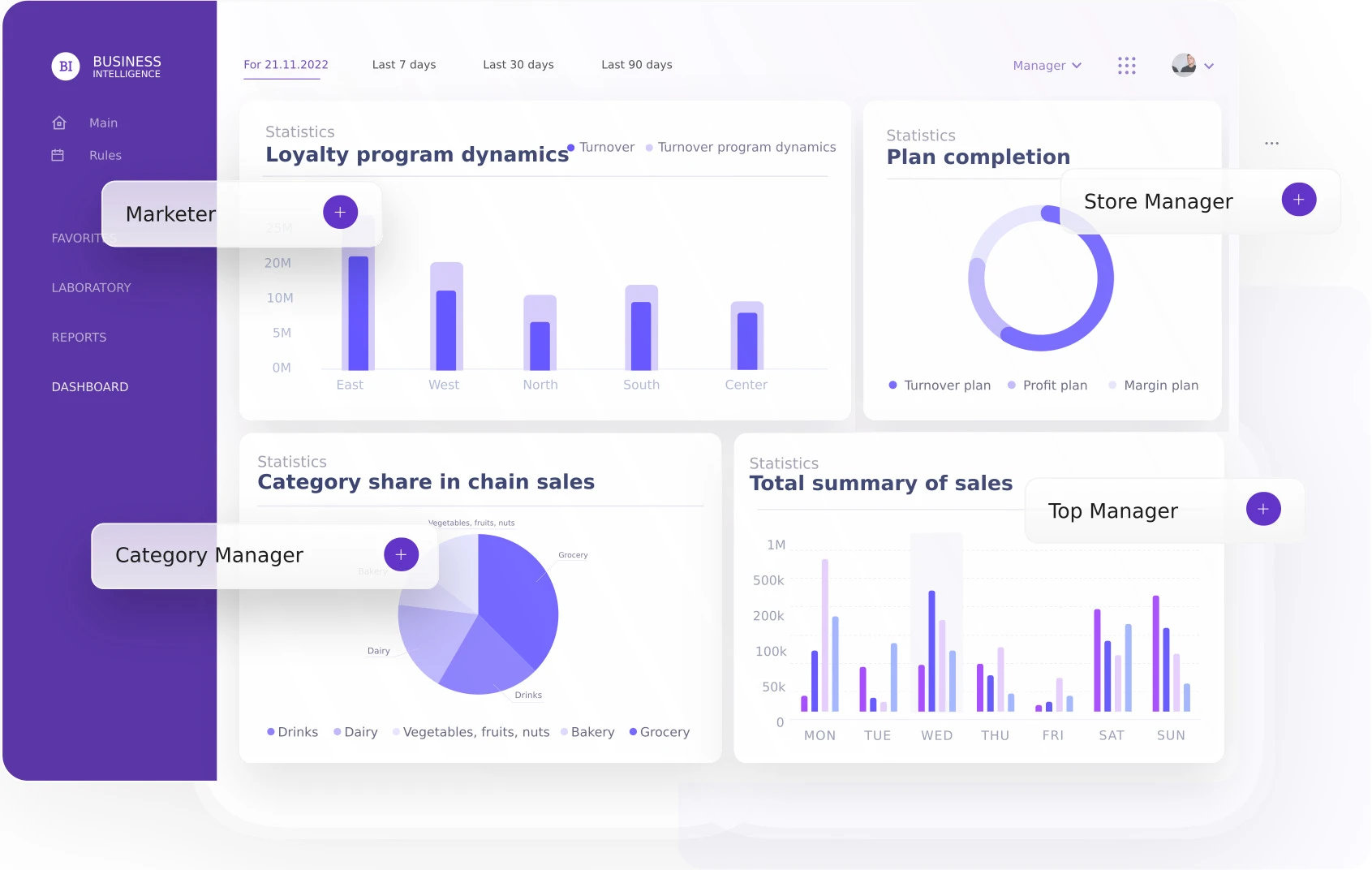
- Loyalty Program Statistics — studies the composition and structure of a chain's loyal customer base, tracks conversion and churn, and breaks down loyal customers by purchase frequency online and in-store.
- Customer Segments of the Loyalty Program — builds segments of loyal customers by chosen indicators, analyzes purchases within each segment, and reduces the time needed to design targeted marketing campaigns.
Integrating program data into a BI solution gives retailers a continuous, reliable view of how customers interact with the brand, which turns loyalty analysis from a one-off survey into an ongoing part of how the business runs.
FAQ
How Does a Loyalty Program Work?
A loyalty program encourages repeat purchases by rewarding customers with points, bonuses, discounts, or other benefits. Customers earn rewards based on their purchases and can use them on future transactions. Many loyalty programs also offer different membership tiers, with additional benefits for customers who shop more frequently or spend more.
How Do You Measure the Effectiveness of a Loyalty Program?
To measure loyalty program effectiveness, retailers should track the number of members, purchase frequency, average transaction value, retention rate, and sales generated by program members. It is also important to compare the spending and purchasing behavior of loyalty members with non-members and calculate the program's return on investment (ROI).
Additional metrics include reward redemption rate, customer engagement with loyalty communications, repeat purchase rate, and customer willingness to recommend the brand. Together, these metrics show whether the program is increasing customer retention, purchase frequency, and revenue.
How Can You Improve the Effectiveness of a Loyalty Program?
Regular analysis of loyalty program data helps retailers identify which rewards and program features drive repeat purchases, higher average transaction values, and stronger customer engagement. Retailers can use these insights to adjust how rewards are earned and redeemed, personalize offers, segment customers, and improve program profitability.

Make decisions based on real data with Datawiz BI


 No credit card required