

More retailers are using AI than ever before. According to FMI — The Food Industry Association, 68% of food retailers used AI in 2026, up from just 47% a year earlier. Generative AI use rose too, from 43% to 59% in the same period.
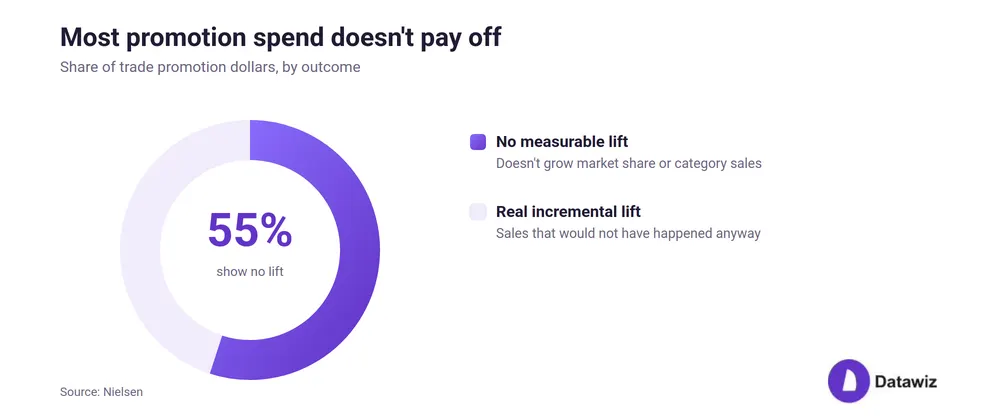
That's fast growth. But adoption numbers only tell half the story. A separate, often-cited Nielsen study found that 55% of trade promotion dollars still fail to increase market share or category growth. In other words, most grocers now have some form of AI in place. Many are still making core merchandising decisions the old way.
This gap is where AI in grocery retail actually earns its keep. Not in flashy customer-facing gadgets, but in the daily grind of deciding what to stock, what to charge, and which promotions are worth running. This article walks through how that works in practice, what to watch for when you set it up, and where teams tend to go wrong.
Key Takeaways
- AI-powered assortment optimization uses store-level sales, seasonality, and demographic data to recommend what each location should stock — not a single national planogram.
- Market basket analysis (also called association rule mining) finds which products are bought together, so retailers can plan cross-sells, bundles, and shelf placement based on actual behavior, not guesswork.
- AI pricing tools model demand elasticity in real time, which is different from simply following competitor prices or applying blanket discounts.
- Roughly 55% of trade promotions fail to pay off. AI-driven promotion analytics measures incremental lift and cannibalization to flag which ones are actually working.
- Good AI analytics setup depends more on data quality and integration than on the sophistication of the algorithm.
- McKinsey estimates AI-driven forecasting cuts demand-forecast errors by 20–50% and can reduce stockout-driven lost sales by up to 65%.
Why Manual Assortment, Pricing, and Promotion Decisions Break Down at Scale
A single supermarket can carry 30,000 to 50,000 SKUs. A regional chain multiplies that across dozens or hundreds of stores, each with its own customer base, local competition, and seasonal quirks. No category manager can track that much variation by hand.
Grocery margins make this worse. Chains margins in food retail typically sit around 1–3%. There's very little room to absorb a bad pricing call or a promotion that quietly cannibalizes full-price sales. Small mistakes, repeated across thousands of SKUs and hundreds of stores, add up fast.
This is exactly the kind of problem AI retail analytics for supermarkets is built to solve. It doesn't replace category managers. It gives them a way to see patterns across a dataset too large for any spreadsheet to hold, and to act on those patterns store by store instead of chain-wide.
How AI-Powered Assortment Optimization Works
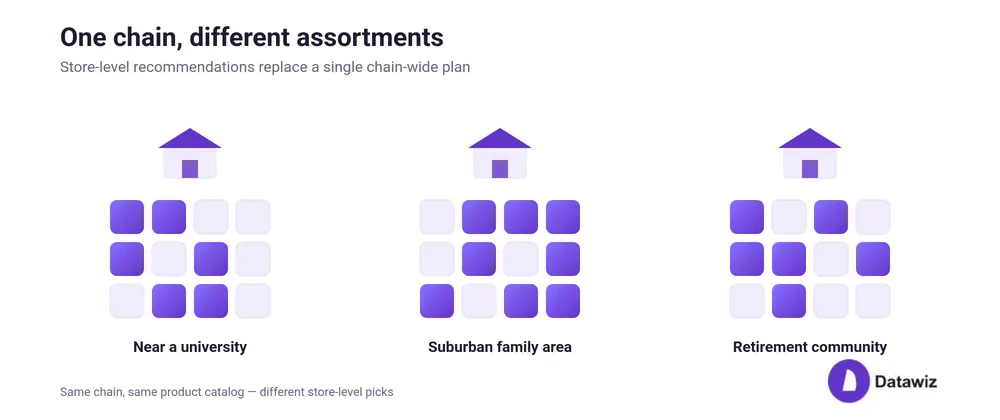
Assortment optimization answers one question: which products should this specific store carry, given its specific customers? That's different from deciding what the whole chain should sell. A store near a university and a store in a retirement community should rarely carry the same mix, even under the same banner.
What Data Feeds an Assortment Optimization Model
AI-powered assortment tools typically draw on:
- Historical sales data: sell-through rates, seasonality, and category performance by store.
- Local demographic and geographic data: household size, income bands, nearby competitors.
- Substitution behavior: what customers buy instead when their preferred item is out of stock.
- Supplier and shelf-space constraints: what's actually feasible to stock and display.
The model looks for patterns across these inputs, then scores each SKU's fit for each store cluster. This is what allows two stores in the same chain to end up with meaningfully different shelf plans, even though they run on identical software.
Kroger's data science division, 84.51°, built a system called KASpR — the Kroger Assortment & Space Recommender. Before KASpR, Kroger's older tools couldn't account for item-level data or attach a dollar value to their own recommendations. That made it hard to trust or prioritize the suggestions.
KASpR fixed that by generating store-specific assortment and space recommendations, backed by machine learning, during remodels and other in-store projects. The result is a system that tells a category manager not just what to change, but why, and what it's worth. This is the level of specificity AI-powered assortment optimization should aim for — not a generic best-practices list, but a recommendation tied to one store's actual customers.
Market Basket Analysis: Finding the Patterns Hiding in Every Receipt
Every basket is a small record of a decision. Multiply that by millions of transactions, and patterns start to surface that no one on staff would ever spot on their own. This is the job of an AI tool for market basket analysis: turning transaction history into rules that a merchandising team can act on.
How Association Rule Mining Works
The standard technique is called association rule mining. It looks for rules in the form "if a customer buys A, they're also likely to buy B." Three numbers matter here:
- Support — how often A and B appear together, out of all transactions.
- Confidence — of the customers who bought A, what percentage also bought B.
- Lift — how much more likely B is to be bought when A is in the basket, compared to B being bought on its own.
What Retailers Do With Basket Insights
Once these rules are identified, they turn into concrete store decisions:
- Placing high-lift items closer together on the shelf.
- Building cross-sell prompts, both in-store and in loyalty app notifications.
- Bundling promotions around genuine buying patterns instead of guessed-at pairings.
- Spotting differences in basket composition by time of day, day of week, or store location
Amazon's "frequently bought together" feature is the most familiar version of this online. In physical grocery, the same math drives shelf layout and bundle design. It just runs quietly in the background.
AI-Driven Dynamic and Demand-Based Pricing
Dynamic pricing in grocery isn't about changing prices every hour the way an airline might. It's about adjusting prices in response to real demand signals — a heatwave driving up ice cream sales, a competitor's price change nearby, or a surplus of near-expiry stock — rather than reviewing prices manually once a quarter.
How AI Pricing Models Decide When (and How Much) to Adjust
These models generally combine a few inputs: current and historical demand, price elasticity by SKU, competitor pricing (where available), inventory levels, and shelf life for perishables. Price elasticity — how much demand shifts in response to a price change — is the core variable. A staple item like milk usually has low elasticity, so a small discount won't move much volume. A discretionary snack item often has higher elasticity, where the same discount can meaningfully lift sales.
The output isn't usually "change every price constantly." It's a recommendation queue: which SKUs would benefit from a price change this week, by how much, and why. Category managers can review and approve, rather than watch prices update on their own.
Measuring and Improving Promotion Effectiveness With AI
Why Most Trade Promotions Don't Pay Off
The Nielsen figure is worth repeating: 55% of trade promotion dollars fail to increase market share or category growth. Part of the reason is that promotions are hard to measure properly. A price drop might move a lot of volume, but if most of that volume would have sold anyway — or if it just pulled sales forward from next month — the promotion wasn't actually incremental.
McKinsey research also found that 65% of customers say targeted promotions are a top reason they make a purchase. So the incentive to run promotions is real. The problem isn't whether to promote — it's knowing which ones are worth the spend.
What AI Adds to Promotion Planning
AI-driven promotion analytics separates real lift from noise by comparing actual sales during a promotion against a modeled baseline of what would have sold anyway. It also flags cannibalization — cases where a promoted item just steals sales from a similar item on the same shelf, rather than growing total category sales.
Benchmarks vary by promotion type. Temporary price reductions on mid-tier grocery items typically generate 20–40% lift. Feature-and-display placements can generate 60–120% lift. Digital coupons without any in-store support tend to land much lower, around 5–15%. Knowing which bracket a planned promotion falls into — before it launches — is what turns promotion planning from a guess into a forecast.
What to Look Out For When Setting Up Retail Analytics
Buying a platform is the easy part. Getting reliable output from it depends on a handful of things that are easy to overlook.
Data Quality and Integration Come First
An AI model is only as good as the data feeding it. If your POS, ERP, and loyalty systems don't talk to each other cleanly, the model will produce recommendations built on gaps and mismatches. Before evaluating any retail BI software on its analytics features, check how it actually connects to your existing systems — and how much manual reconciliation that connection still requires.
Avoid Over-Automating Pricing Decisions
Full automation sounds efficient, but pricing errors compound fast when nobody reviews them. A model can misread a data anomaly — a stockout, a data entry error, a one-off bulk order — as a genuine demand shift. Keep a human review step for price changes above a certain threshold, at least until the model has a track record in your specific stores.
Start With One Category, Not the Whole Store
Rolling out AI-powered assortment optimization across every category at once makes it hard to tell what's working. Pick one category with clear, measurable outcomes — produce, for instance, where waste and stockouts are easy to track — and use it to validate the approach before expanding.
Make Sure Store Managers Can Actually Use the Output
A model that produces a spreadsheet nobody opens isn't helping anyone. The most useful systems translate recommendations into plain, specific actions: which SKUs to add, which to drop, which prices to adjust this week. If your team needs a data analyst to interpret every report, the tool isn't finished yet.
The Role of BI Platforms in Bringing This Together
Assortment, pricing, and promotion decisions don't happen in isolation — a price change affects basket composition, which affects assortment relevance, which affects promotion timing. Retail BI platforms exist to bring these threads into one place, instead of leaving each decision to a separate spreadsheet or team.
Datawiz BI is built around this kind of connected view, drawing on sales, inventory, and store-level data to support assortment, pricing, and promotion decisions from a single platform. Its AI assistant, Wizora, lets category managers and analysts ask direct questions about their own data — like which SKUs are underperforming in a specific store cluster, or how a recent promotion affected basket size — and get an answer without writing a query or waiting on a report. That kind of access matters more than any single algorithm: the fastest way to waste a good AI model is to lock its output behind a dashboard only one person on the team knows how to read.
Where This Is Headed
The next shift is toward tighter integration between these functions rather than more powerful individual models. Pricing decisions increasingly factor in real-time basket data. Promotion planning increasingly draws on assortment-level forecasts, not just historical promo performance. The retailers pulling ahead aren't necessarily using more advanced AI — they're connecting what they already have more effectively.
FAQ
What is AI in grocery retail, exactly?
AI in grocery retail refers to machine learning and data analytics applied to retail decisions — what to stock, how to price it, which promotions to run, and how to forecast demand. It's distinct from customer-facing tools like chatbots or checkout-free stores, though both fall under the same broad label.
How does AI-powered assortment optimization differ from traditional category management?
Traditional category management often applies one plan across many stores, with adjustments made manually and infrequently. AI-powered assortment optimization generates store-specific recommendations based on that location's actual sales and customer data, and updates them continuously as conditions change.
What is market basket analysis used for in supermarkets?
It's used to find which products are commonly bought together, so retailers can improve shelf placement, build accurate cross-sell offers, and design promotions around real buying patterns instead of assumptions.
Does AI pricing mean prices change constantly, like airline tickets?
No. In grocery, AI pricing tools typically generate a recommendation queue for category managers to review, rather than changing prices automatically and continuously. The goal is faster, more accurate response to demand shifts — not constant repricing.
How much of trade promotion spend actually works?
According to Nielsen, around 55% of trade promotion dollars fail to increase market share or category growth. AI-driven promotion analytics is aimed at closing that gap by measuring true incremental lift rather than gross sales during the promotion window.
What should a retailer check before choosing retail BI software?
Start with integration: how well the platform connects to your existing POS, ERP, and loyalty systems. Then check whether its output is something store-level staff can act on directly, not just something a data analyst can interpret.
Can smaller grocery chains benefit from AI analytics, or is this only for large retailers?
Smaller chains can benefit, often faster than large ones, because they have fewer legacy systems to integrate. Starting with a single category or store cluster, rather than a chain-wide rollout, is a practical way to prove value before scaling up.

Make decisions based on real data with Datawiz BI


 No credit card required