
Last updated: October 6, 2026
What is Merchandise Accounting?
Effective store accounting is the foundation of successful retail store management. Without a clear understanding of what goods are in stock, their movement, and inventory status, a business risks losing control of operational processes.
Merchandise accounting is a system for recording all inventory transactions, from receipt from suppliers to sale to the end consumer. It is the basis for controlling balances, analyzing sales, and making strategic decisions.
Key principles of successful accounting:
- Process automation. Modern software minimizes manual data entry errors.
- Regular inventory. It allows you to keep data up to date and identify possible discrepancies.
- Transparency of operations. All actions with goods should be recorded: receiving, moving, selling, writing off.
- Data analysis. Accounting is not only control, but also a tool for obtaining analytics, which helps make strategic decisions.
Why is Store Accounting Important for Retailers?
- Control of finances. Without accounting, it is difficult to understand where funds are being spent and how efficiently they are working.
- Avoiding shortages and surpluses. A lack of merchandise can lead to loss of customers, and excess can lead to a capital freeze.
- Theft prevention. Accounting in a store helps identify discrepancies between actual balances and data in the system.
- Increased competitiveness. Stores that actively use accounting systems react faster to market changes and better meet the needs of customers.
How to Keep Records in the Store: Step by Step
1. Receipt of goods
At this stage, it is necessary to carefully check the compliance of the received goods with the order. Compare the data on the delivery note with the actual quantity and quality of products. Make sure that all items correspond to the order in terms of characteristics, quantity, and expiration date, if it is important. If you find discrepancies, document them and notify the supplier to resolve the situation.
2. Recording of goods
After goods are received and inspected, they must be recorded in the accounting system. This process involves entering detailed information about the goods: name, characteristics (color, size, brand), quantity, and cost. The accuracy and completeness of this data will determine the continued effectiveness of inventory control.
3. Placement of goods
For the convenience of further work, products should be properly arranged in the warehouse or in the sales area. Group them by categories to quickly find the necessary products. Use labeling with barcodes or QR codes, and create a diagram of the warehouse that provides logic and orderliness in the arrangement of goods.
4. Tracking the movement of goods
Tracking the movement of goods is a key accounting step. This should be done by taking inventory on a regular basis and recording any changes in balances. The main methods used are FIFO (goods received first are sold first), LIFO (last-in-first-out goods are sold last-in-first-out), or weighted average cost, which takes into account the average price of all purchased lots.
5. Sales and data updates
The sale of each item must be recorded in the accounting system in a timely manner. This allows you to automatically update inventory data and analyze which items are in highest demand, which provides transparency in processes and helps plan future purchases.
6. Write-offs and re-accounting
Sometimes goods need to be written off due to spoilage, expiration, or other reasons. Regular inventory counting helps identify items that need to be written off in time and avoid wastage. All such transactions should be documented to maintain transparency and accurate accounting.
Each of these steps is important to create a reliable accounting system that will help you effectively manage your store's inventory.
KPIs and Formulas for Measuring Accounting Performance
A list of KPI names doesn't tell you whether your accounting is actually working. The formulas below turn each indicator into something you can calculate directly from your accounting records and compare period over period.
- Average receipt = Total Revenue ÷ Number of Transactions. Reflects the average amount spent by one customer per store visit. A falling average receipt despite stable foot traffic often points to a weaker product mix or fewer add-on sales, not a traffic problem.
- Merchandise turnover (inventory turnover) = Cost of Goods Sold ÷ Average Inventory (at cost). Shows how many times inventory is sold and replaced over a period. Low turnover combined with rising storage costs is a direct signal that accounting data isn't being used to adjust purchasing.
- Sell-through rate = (Units Sold ÷ Units Received) × 100%. Shows what share of received stock has actually sold within a period, which is a faster warning sign than turnover alone, since it flags a specific delivery or SKU batch rather than only a category-level trend.
- Stock level accuracy = (Units Recorded in System ÷ Units Physically Counted) × 100%. Compares what the accounting system says is on the shelf against what a physical count actually finds. A gap here is the clearest sign that the recording step (Step 2 above) isn't being followed consistently.
- Shrinkage rate = (Recorded Inventory Value − Actual Inventory Value) ÷ Recorded Inventory Value × 100%. Measures loss from theft, damage, or administrative error. This is the KPI most directly tied to the "theft prevention" benefit of good accounting, and it only shows up clearly when regular physical inventory counts are compared against system records.
- Returns rate = (Units Returned ÷ Units Sold) × 100%. An indicator of assortment quality and service levels. A rising returns rate on a specific SKU is often a data-entry or description error upstream rather than a product defect.
Tracked together and reviewed on a regular cadence, these formulas turn routine bookkeeping into an early-warning system: a store can catch a shrinkage problem or a stock-accuracy gap within weeks instead of discovering it at the next full inventory count.
Datawiz BI Retail Accounting Automation Software
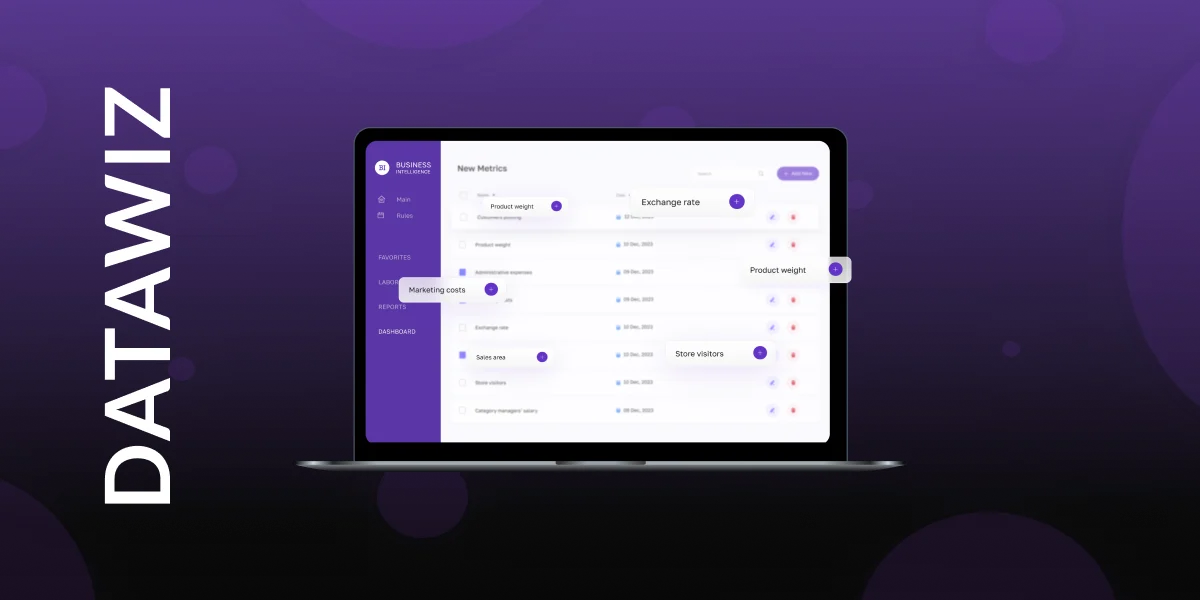
For quality retail accounting, it is advisable to implement modern software solutions that can cover all key aspects of business management. Using the Datawiz BI tool allows you not only to automate processes but also to receive relevant analytics in real time.
Modern retail programs help:
- Control product balances. You will always know which items need replenishment and which are accumulating in excess.
- Track sales and financial performance. This allows you to quickly assess the performance of a store or the entire chain.
- Automate inventory. This makes the inventory process more accurate and less time-consuming.
- Analyze key performance indicators (KPIs). Tracking average receipt, inventory turnover, or return rate allows you to better understand business results and make informed decisions.
Business intelligence systems provide deeper analysis of data, letting you identify high-margin products, track sales trends, and respond to changes in demand in a timely manner.
Accounting for goods in the store is the basis for building a transparent and efficient business. By following a step-by-step plan and implementing proven tools, you will be able to make your store not only easy to manage, but also as cost-effective as possible.
FAQ
What's the difference between merchandise accounting and inventory management?
Merchandise accounting is the system of recording every transaction a product goes through, from receipt to sale to write-off. Inventory management is the broader discipline of deciding how much stock to hold and where. Accounting provides the data; inventory management is one of the decisions made using that data.
Should I use FIFO, LIFO, or weighted average cost?
FIFO fits most physical retail well, especially for perishable or trend-sensitive goods, since it assumes the oldest stock sells first and keeps reported inventory value closer to current replacement cost. LIFO is less common in retail and more relevant where unit costs rise steadily and tax treatment favors it. Weighted average works best for goods that are functionally identical regardless of purchase date, like bulk commodities, where tracking individual batches adds complexity without much benefit.
How often should a store do a full inventory count?
A full physical count once a quarter is a reasonable baseline for most stores, with spot checks on high-value or fast-moving categories more frequently. Stores with higher shrinkage risk, more SKUs, or multiple staff handling stock typically benefit from monthly counts on at least their Category A items.
What causes the biggest accounting discrepancies in a retail store?
The most common causes are inconsistent recording at the receiving stage (Step 1 and 2 above), unrecorded write-offs for damaged or expired goods, and theft. Automating the recording step and running regular counts addresses the first two directly; shrinkage rate tracking is what surfaces the third.
Can accounting software fully replace manual stock counts?
No. Software removes manual entry errors and gives real-time visibility into what the system believes is in stock, but it can't detect physical loss on its own. Regular physical counts remain necessary to catch the gap between recorded and actual inventory, which is exactly what the stock level accuracy and shrinkage rate formulas measure.

Make decisions based on real data with Datawiz BI



 No credit card required