 Novedades

Inventory imbalance is one of the most expensive and structurally dangerous problems in retail operations.Out-of-stocksdirectly destroy revenue, customer trust, and brand loyalty. Overstocks freeze working capital, increase storage costs, accelerate product obsolescence, and create waste. Most retail chains suffer from both simultaneously — which is not a contradiction, but a symptom of broken inventory logic.
Modern retail no longer struggles because of “bad forecasting” or “human mistakes.” It struggles because of fragmented systems, delayed data, disconnected departments, and reactive decision-making models. This is where ERP inventory management becomes not just a tool, but a structural transformation mechanism that changes how inventory is planned, controlled, and synchronized across the business.
Instead of fighting stock issues manually, ERP systems redesign the entire logic of inventory flow — turning inventory from an operational risk into a controllable business asset.
What Is An ERP Inventory Management System?
ERP inventory management system is a unified digital environment where inventory becomes part of an integrated business model rather than a separate operational function.
An erp inventory system connects inventory data with procurement, sales, logistics, finance, forecasting, and warehouse operations in one centralized platform. This creates a single source of truth for all stock-related decisions across the organization.
Unlike traditional stock tools or spreadsheets, ERP systems operate on continuous data flow instead of periodic reporting. This means inventory decisions are based on live operational reality, not historical snapshots.
In practical terms, enterprise resource planninginventory managementmeans that inventory is no longer managed “locally” by stores or warehouses. It is managed centrally as a strategic business resource, where every movement, transaction, and forecast directly influences planning, budgeting, supply chain operations, and sales strategy.
This transforms inventory from a reactive operational task into a proactive management discipline.
Typical Inventory Management Problems in Retail Chains
Retail inventory problems rarely come from one source. They emerge from systemic fragmentation across departments, systems, and decision layers.
The most common structural issues include:
- Data fragmentation between stores, warehouses, suppliers, and finance
- Delayed reporting that creates blind operational decisions
- Manual forecasting based on assumptions instead of analytics
- Disconnected planning cycles between procurement and sales
- Local optimization that harms global inventory balance
- Poor demand visibility at SKU and location levels
- Reactivereplenishmentinstead of predictive planning
These problems lead to predictable outcomes: stores with empty shelves for fast-moving items and warehouses filled with slow-moving stock. This paradox exists because inventory is not managed as a system — it is managed as isolated operations.
Traditional tools simply cannot handle the complexity of modern retail chains with multi-store operations, omnichannel sales, promotional volatility, and supply chain variability.
How Does ERP Inventory Management Help Reduce Out-of-Stocks and Overstocks?
ERP reduces stock imbalances by changing the structure of inventory control itself — not by adding manual control layers.
The core transformation happens through system-level logic, not human intervention.
Centralized inventory visibility ensures that all stock movements — sales, transfers, deliveries, returns, and replenishment — are recorded in real time. This creates a live operational picture instead of fragmented reports. Retailers stop making decisions based on outdated data and begin operating on real demand signals.
Predictivedemand forecastingreplaces assumption-based planning with analytics. ERP systems analyze historical sales, seasonal patterns, promotional effects, regional behavior, and SKU performance to forecast actual future demand. Procurement decisions become demand-driven instead of intuition-driven.
Automated replenishment logic stabilizes inventory flows by replacing emotional and reactive ordering cycles. Stock levels are maintained through demand-based thresholds, safety stock models, and automated reorder rules. This eliminates panic закупки, fear-based overstocking, and emergency replenishment patterns.
Inventory redistribution becomes a strategic tool. Excess stock in one location is no longer dead capital — it becomes a transferable resource. ERP systems enable dynamic stock rebalancing across stores and warehouses, reducing both shortages and surplus without new purchases.
Operational synchronization removes structural conflicts between departments. Sales, procurement, logistics, finance, and warehouse operations work inside a single system using unified data. This prevents contradictory decisions where one department creates overstock while another creates shortages.
With erp for inventory management, inventory balance becomes a system output — not a daily operational crisis.
The Impact of ERP Implementation on Inventory Management
ERP implementation creates measurable, long-term transformation in how inventory behaves inside the business model.
The business impact typically includes:
- Reduced stockout frequency and shelf gaps
- Lower excess inventory and dead stock accumulation
- Higher inventory turnover rates
- More stable supply planning
- Improved working capital efficiency
- Reduced write-offs and waste
- Better supplier coordination
- More accurate financial forecasting
- Stronger demand-response alignment
ERP does not just improve performance, it stabilizes inventory behavior at scale.
This allows retail chains to grow without multiplying chaos. Expansion no longer increases risk — it increases control.
Key ERP Features for Inventory Management
Effective ERP inventory control is built on several core functional capabilities:
- Real-time inventory tracking. Ensures continuous visibility of stock across stores, warehouses, and transit locations.
- Automated replenishment systems. Maintain stock levels using demand-driven reorder logic instead of manual decisions.
- Predictive demand forecasting. Uses historical and behavioral data to anticipate future demand accurately.
- Multi-location inventory synchronization. Aligns stock across multiple stores and distribution centers.
- Warehouse flow optimization. Improves internal logistics, storage efficiency, and picking processes.
- Financial integration. Links inventory data with financial planning, cost control, and cash flow management.
These features work as one system — not as separate modules — which is why erp stock management creates structural change instead of operational patching.
Retail Analytics Layer: The Role of Data Intelligence
ERP systems manage operational structure, but modern retail requires analytical intelligence on top of operational data.
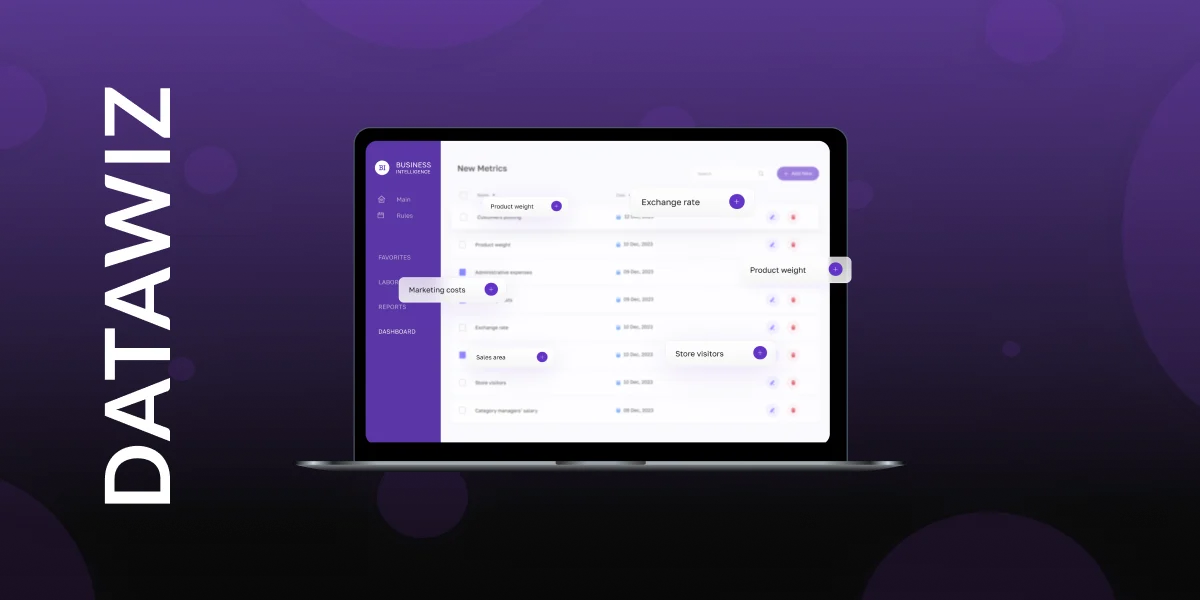
This is where retail analytics platforms enhance ERP ecosystems. One example isDatawizBusiness Intelligence, which provides deep analytical visibility into demand patterns, store performance, SKU behavior, and inventory efficiency.
By combining ERP infrastructure with advanced analytics, retail chains gain not only control — but predictive intelligence that enables strategic planning, proactive replenishment, and continuous optimization of inventory flows.
FAQ
What’s the best ERP inventory management system for a multi-store retail chain?
The best system is not defined by brand — it is defined by architecture. A strong ERP must support real-time multi-location synchronization, predictive forecasting, automated replenishment, and centralized inventory governance. For analytics-driven environments, ERP systems integrated with platforms like Datawiz allow retail chains to combine operational control with demand intelligence.
ERP inventory management vs Excel-based tracking — what’s the real difference in efficiency?
Excel-based tracking relies on manual updates and delayed reporting. ERP provides automation, real-time data, predictive analytics, and system-level integration.
How does ERP help prevent seasonal stock imbalances?
ERP systems use historical seasonality data, demand trends, and predictive models to prepare inventory levels in advance. This prevents seasonal panic закупки and post-season overstock accumulation.
Can ERP reduce inventory waste and write-offs?
Yes. By aligning procurement with real demand, enabling redistribution, and optimizing stock rotation, ERP systems directly reduce obsolescence, expiration, and dead stock formation.
Is ERP suitable for fast-growing retail chains?
ERP is essential for scaling. Without system-level inventory control, growth multiplies chaos. With ERP, growth increases stability and predictability.



 ¡No se necesita tarjeta bancaria!